







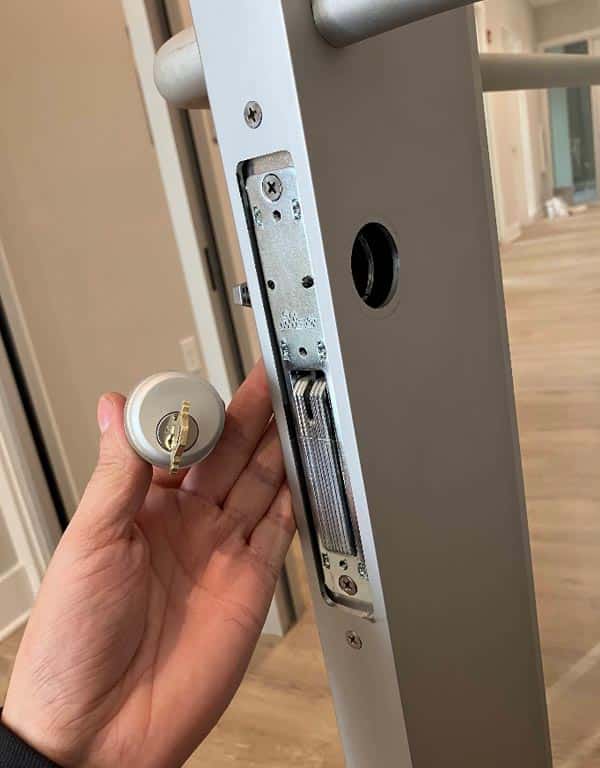
What Lock Grades Actually Mean
Lock grades in the United States are set by ANSI, the American National Standards Institute, in partnership with BHMA, the Builders Hardware Manufacturers Association. The grading system runs from Grade 1 through Grade 3, with Grade 1 being the most durable and Grade 3 being the lightest duty. Each grade is tested against standards that measure cycle life, security, and resistance to forced entry.
- Grade 1 locks are rated for 250,000 open and close cycles without failure
- Grade 2 locks are rated for 150,000 cycles
- Grade 3 locks, most common in residential settings, are rated for 80,000 cycles
For a Memphis business that sees dozens or hundreds of people moving through its doors every day, the difference between those ratings is significant. A Grade 3 lock on a high-traffic commercial door can wear out in months.
Grade 1 Locks and When Your Business Needs Them
Grade 1 is the standard for most commercial applications in Memphis. These locks handle heavy daily use, resist physical attacks, and maintain reliable operation over years of service. They’re the right choice for main entry doors, high-traffic corridors, exterior doors, and any door that faces the public.
Businesses in retail, healthcare, hospitality, and property management should default to Grade 1 hardware on all primary access points. If your building uses a master key system to manage access across multiple doors, all locks in that system should be Grade 1 to hold up under shared use and regular rekeying cycles. Grade 1 locks also pair better with access control systems because the hardware can handle the repeated electronic and mechanical cycling those systems require.
Grade 2 Locks and Where They Fit
Grade 2 locks work well for interior doors in lower-traffic commercial spaces, including private offices, conference rooms, storage areas, or secondary corridors that only a handful of employees use each day. These doors don’t face the same volume or force as your main entry, so Grade 1 is often more than what the application requires.
That said, Grade 2 locks should never go on exterior doors or any access point where security is a primary concern. Placing Grade 2 hardware on an exterior door is a common mistake in commercial construction, and one we frequently uncover when a business owner asks why their hardware failed or why a door was compromised.
How Door Type and Traffic Volume Should Guide Your Choice
The door itself matters just as much as the grade. Consider these factors when selecting hardware for each opening:
- Heavy steel exterior doors with hydraulic closers put more stress on a lock than lightweight interior doors
- High humidity in a Memphis summer can cause door frames to swell, adding resistance and accelerating wear
- Doors that don’t align cleanly with their frames create friction that shortens the life of even well-graded locks
- A door used by 200 people daily has a very different wear profile than one used by 10
For exterior doors in busy Memphis commercial spaces, Grade 1 is the baseline. For interior doors with moderate use, Grade 2 is often appropriate. Grade 3 hardware belongs in residential settings, not on commercial doors of any kind.
Pairing Lock Grade with the Right Hardware
A Grade 1 lock installed on a weak door frame or paired with a low-quality strike plate doesn’t deliver Grade 1 security. The frame, strike plate, hinge quality, and door material all contribute to how well an entry point holds up under pressure.
For businesses that have experienced a break-in or operate in higher-risk areas of Shelby County, it’s worth evaluating the full door assembly, not just the lock cylinder. Door frame reinforcement, upgraded strike plates, and continuous hinges on outward-swinging doors all raise the overall security of the opening. We provide door repair and installation services alongside lock work, making it easier to assess and address the full picture in one visit. For businesses that want camera coverage at entry points, commercial alarm and CCTV systems can be integrated with your door hardware for layered protection.
Get the Right Lock Grade Installed at Your Memphis Business
Choosing the right lock grade affects how long your hardware lasts, how well it holds up under daily use, and how your building performs if someone tries to force entry. Getting it right from the start saves money and reduces the risk of failure at the worst possible time. We provide mobile commercial locksmith services across Memphis, Shelby County, Bartlett, Germantown, Collierville, Cordova, and surrounding Mid-South areas. All lock and hardware installations are backed by a 6-month warranty, and service is available 7 days a week. Contact The Lock Doc to schedule an on-site assessment and get the right hardware installed for your specific doors and traffic levels.